Common Semiconductor Terms Explained: A Beginner-Friendly Guide
Semiconductors are an important part of modern technology. They are used in smartphones, computers, vehicles, medical equipment, communication systems, and many other electronic devices. As technology continues to develop, understanding semiconductor-related terminology has become useful for students, technology readers, and general audiences.
Understanding semiconductors starts with knowing what words mean. Instead of jargon, plain talk breaks down ideas here. Anyone can follow along, even without engineering school behind them. Words that sound complex become clear through everyday examples. Learning one term builds a small foundation. Then another piece fits next to it. Clarity grows slowly, like stacking blocks. This isn’t about mastering physics overnight. It’s about making space for real comprehension, bit by bit.
Understanding Semiconductor Basics
What Is a Semiconductor?
Not quite a gatekeeper, yet not fully open - semiconductors let current pass only when things like temperature or voltage shift just right. Their power lies somewhere above rubber but below copper, acting in the middle where behavior changes on demand.
Common semiconductor materials include:
- Silicon
- Germanium
- Gallium arsenide
Found everywhere in tech, silicon stands out due to its reliability and smooth fit with how chips are made. Its performance stays strong while matching well with standard production methods.
Why Semiconductor Words Are Important
Learning semiconductor terminology helps readers:
- Understand modern electronics
- Follow technology news more easily
- Learn how electronic devices function
- Build foundational knowledge for technical education
Few words from chip-making pop up elsewhere - like in smart machines, phone networks, car tech, or gadgets you hold. Sometimes they travel beyond labs into daily devices.
Basic Semiconductor Words Made Clear
Wafer
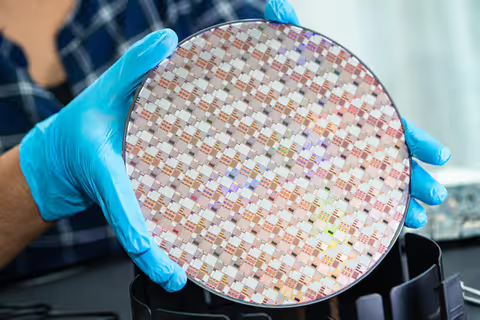
A disc made of silicon forms the base for tiny electronic parts. On its surface, workers create circuitry step by step. This round piece stays flat and smooth throughout production. Most chips start life this way, layer by layer.
Smoothness matters most when making wafers meant to hold small electronics. Tiny parts need a flawless base, so each wafer gets detailed attention during production.
Chip
A sliver of silicon forms the base of what we call a chip. Built into it are tiny pathways that handle data or manage functions inside devices. These pieces come from slicing up larger wafers made of semiconducting material.
Chips are found in devices such as:
- Smartphones
- Laptops
- Smart televisions
- Industrial machines
Integrated Circuit (IC)
Inside one tiny piece of silicon hides what people sometimes name an IC. This little slab holds loads of parts that usually stand separate in electronics. Instead of spreading out, they’re packed tight on a miniature surface.
ICs may contain:
- Transistors
- Resistors
- Capacitors
Smaller size comes from how parts work together inside. Efficiency jumps when pieces share tasks instead of stacking up.
Transistor
Inside your devices, a small part called a transistor manages electric flow like a gatekeeper. This piece ranks among the key breakthroughs shaping modern tech.
Built into today’s chips are countless tiny switches acting in sync. Transistors by the billion now fit on a single slice of silicon.
Semiconductor Fabrication
Fabrication means making semiconductor devices step by step. Each stage follows a specific pattern, yet builds on what came before it. One phase leads into another, though each has its own role. Steps unfold in sequence, still they depend on precise conditions. The method involves careful handling, while relying on controlled environments. Parts take shape gradually, even as materials change form
- Wafer preparation
- Circuit pattern creation
- Etching
- Testing
- Packaging
Semiconductor fabrication requires highly controlled environments known as cleanrooms.
Cleanroom
Inside a cleanroom, air stays nearly free of dust by strict control measures. Because microscopic bits floating around might ruin sensitive parts when building chips.
Inside sterile rooms, personnel pull on full-body outfits so particles stay low. Protection comes through sealed clothing when handling sensitive materials.
Key Semiconductor Parts and Ideas
CPU Central Processing Unit
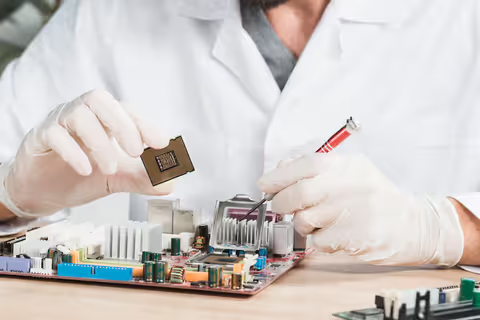
Inside every machine, the CPU takes charge like a conductor in an orchestra. This piece handles tasks by breaking them into tiny steps. One after another, it solves problems using logic and speed.
CPUs are used in:
- Computers
- Tablets
- Servers
- Embedded systems
Graphics Processing Unit
Picture this - handling visuals and images is what a GPU does best. Still, it pulls double duty across AI tasks alongside heavy-duty science number crunching.
Memory Chip
Information sticks around for a bit, sometimes forever, inside memory chips.
Among everyday kinds of memory are
Memory Type Purpose RAM Temporary working memory ROM Permanent stored instructions Flash Memory Long-term storage
Node Size
A tiny measurement tells how small parts of a chip can get. This number, shown in billionths of a meter, marks progress in making electronics faster. Tiny steps forward happen here, hidden inside devices people carry every day.
Smaller node sizes often allow:
- Higher efficiency
- Faster performance
- Lower power consumption
Examples include:
- 7nm
- 5nm
- 3nm
Nanometer (nm)
A tiny measure - that’s what a nanometer means.
1nm=10−9meters1\text{ nm} = 10^{-9}\text{ meters}1 nm=10−9 meters
Tiny pieces inside computer parts get made super small so extra bits can squeeze onto tiny boards.
Understanding semiconductor device operation
Electricity Control
Electrons move through semiconductors because their flow gets managed precisely. Because of that precise handling, gadgets turn signals off or on smoothly.
The process is essential for:
- Computing
- Data storage
- Signal processing
Doping
Adding impurities into semiconductors changes how well they carry current. This tweak happens by slipping extra atoms into the material’s structure. Carrying electricity gets easier when these foreign particles mix in. The base substance gains new electrical traits through this method. Performance shifts because the added elements alter electron flow. Conductivity climbs once those unwanted bits settle inside.
Some examples are these ones here. Another kind you might see looks like that
- N-type semiconductor
- P-type semiconductor
Together, these substances create parts such as diodes and transistors. Components come alive when the materials join in this way.
Diode
Flowing mostly one way, a diode guides electric current through its path.
Diodes are commonly used in:
- Power supplies
- Signal processing
- Lighting systems
Microprocessor
A tiny chip built for running commands, it handles math tasks. Though small, its job powers many devices around us. This piece works quietly inside gadgets we use every day.
A tiny chip handles many tasks together, packed tightly in one piece. Built small, it works through several steps without extra parts around it.
Semiconductor Technology Matters
Consumer Electronics
From phones to fridges, semiconductors help run most gadgets people use every day
- Smartphones
- Smartwatches
- Home appliances
- Gaming systems
Communication Systems
Faster signals move through tiny silicon pieces inside today's devices. These chips handle data flow without slowing down entire networks.
Applications include:
- Mobile networks
- Satellite systems
- Internet infrastructure
Automotive Technology
Vehicles now use semiconductor chips for:
- Navigation systems
- Safety features
- Engine management
- Electric vehicle controls
artificial intelligence meets data processing
Faster chips plus smarter data storage help machines learn and handle tasks online. What runs behind digital services often relies on upgraded brains inside computers.
Semiconductors help improve:
- Data analysis speed
- Machine learning systems
- Automation technologies
Recent Trends in Semiconductor Technology
Smaller Manufacturing Nodes
Fine-tuned circuits now dominate chip manufacturing. As dimensions shrink, performance climbs - yet demand less electricity.
AI-Focused Chips
New semiconductor designs are being optimized for artificial intelligence tasks such as:
- Image recognition
- Natural language processing
- Data training systems
Sustainable Manufacturing
Finding new methods takes effort when cutting down power use shows up in chip making. Waste from materials gets another look as factories adjust how they operate. Steps toward lower resource loss come slowly, yet changes do happen along the way.
Advanced Packaging
Putting chips together in new ways helps them run faster while fitting parts that cooperate better inside tiny spaces.
Common Mistakes and Considerations
Chips and Processors Often Mixed Up
Chips come in many forms beyond just processors. While one might handle computing, others take on jobs like storing data or managing internet connections. A chip could be built purely for visuals instead of general brainwork. Different roles mean different designs inside each tiny package.
Smaller Not Always Better
Even tiny nodes can boost speed, yet how well things run still ties to layout choices along with overall structure care.
Ignoring Heat Management
Fans spinning inside machines help carry warmth away. When things run, they warm up - so moving air keeps them steady.
Overlooking Manufacturing Complexity
Fine details matter most when building chips, where exactness shapes every step. Production leans on cutting-edge methods that push limits quietly behind the scenes.
Conclusion
Out there among tech talks, knowing basic chip words helps everything click a bit faster. Picture wafers - thin discs where tiny electronic parts are built one by one. Transistors act like microscopic switches controlling electric flow inside devices. These pieces join together into what we call integrated circuits, packed neatly onto small chips. Inside your laptop or phone, the CPU runs things using these components. How they’re made - the step-by-step building methods - is called fabrication, shaping today’s digital world behind the scenes.
Computing, communication, transport - each leans heavily on tiny chips that power modern life. When new tech emerges, knowing how semiconductors work becomes less optional, more everyday knowledge.