Chip Manufacturing Technology: A Complete Guide to Modern Semiconductor Production
Chip manufacturing technology is the foundation of modern electronics. From smartphones and laptops to smart cards and IoT devices, computer chips power almost every digital system we use today.
Understanding the computer chips manufacturing process helps explain how tiny silicon components perform complex tasks efficiently. As industries evolve, advancements in chip production have become essential for faster computing, better connectivity, and improved energy efficiency.
This article provides a clear and simple overview of chip manufacturing, its importance, processes, and current trends.
Overview of Chip Manufacturing Technology
Chip manufacturing technology refers to the process of designing and producing semiconductor devices, commonly known as integrated circuits or microchips.
These chips are made from materials like silicon and are used in:
- Computers and laptops
- Mobile devices
- Smart cards
- IoT devices (e.g., LoRaWAN chipset-based systems)
- Automotive electronics
The industry includes biggest computer chip manufacturers, as well as specialized producers like system on a chip manufacturers and smart card manufacturers.
Importance of Chip Manufacturing Technology
Chip manufacturing plays a critical role in modern technology. Without it, digital transformation would not be possible.
Key Benefits:
- Performance Enhancement: Enables faster processing and multitasking
- Miniaturization: Allows devices to become smaller and more powerful
- Energy Efficiency: Reduces power consumption in electronics
- Connectivity: Supports communication technologies like LoRaWAN chipset systems
- Innovation Support: Drives advancements in AI, automation, and cloud computing
Types of Chips and Key Categories
Different types of chips are produced based on their application and functionality.
1. System on a Chip (SoC)
- Combines CPU, memory, and peripherals into a single chip
- Widely used in smartphones and embedded systems
- Produced by leading system on a chip manufacturers
2. Memory Chips
- Store data temporarily or permanently
- Includes DRAM and NAND flash
- Many Chinese DRAM manufacturers contribute to global supply
3. Microprocessors
- Perform calculations and execute instructions
- Found in computers and servers
4. Smart Card Chips
- Used in SIM cards, banking cards, and ID systems
- Produced by specialized smart card manufacturers
5. IoT and Communication Chips
- Includes technologies like LoRaWAN chipset
- Enables long-range, low-power communication
Electronic Chip Manufacturing Process
The electronic chip manufacturing process is complex and involves multiple stages. It requires precision, clean environments, and advanced equipment.
1. Silicon Wafer Preparation
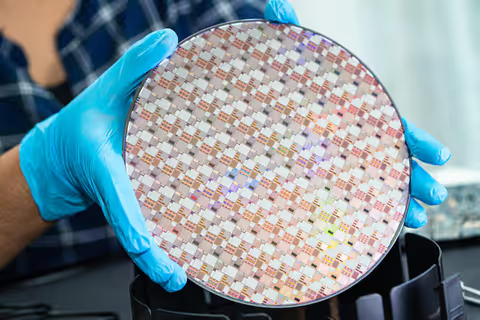
- Silicon is purified and shaped into thin wafers
- Acts as the base material for chips
2. Photolithography
- Patterns are transferred onto the wafer using light
- Defines the structure of circuits
3. Etching
- Removes unwanted material
- Creates microscopic pathways
4. Doping
- Adds impurities to modify electrical properties
- Helps control conductivity
5. Deposition
- Thin layers of materials are added
- Builds the chip structure layer by layer
6. Testing and Packaging
- Chips are tested for defects
- Packaged for integration into devices
Computer Chips Manufacturing Process (Simplified Table)
| Stage | Purpose | Key Outcome |
|---|---|---|
| Wafer Fabrication | Create silicon base | Smooth wafer surface |
| Lithography | Design circuit patterns | Circuit layout defined |
| Etching | Remove excess material | Circuit pathways formed |
| Doping | Adjust electrical properties | Controlled conductivity |
| Layer Deposition | Add functional layers | Multi-layer chip structure |
| Testing & Packaging | Ensure quality and usability | Ready-to-use chips |
Key Players in Chip Manufacturing
The semiconductor industry includes several global companies. Some are considered biggest computer chip manufacturers, while others specialize in specific areas.
Categories of Manufacturers:
- Foundries: Produce chips designed by other companies
- Integrated Device Manufacturers (IDMs): Design and manufacture chips
- Fabless Companies: Focus only on chip design
There is also competition among manufacturers, often discussed in terms like TSMC competitor, referring to companies competing with leading chip foundries.
Latest Trends in Chip Manufacturing Technology (2025–2026)
Chip manufacturing continues to evolve rapidly. Here are some important trends:
1. Smaller Process Nodes
- Chips are becoming smaller (e.g., 3nm, 2nm technologies)
- Improves speed and efficiency
2. AI-Driven Chip Design
- Artificial intelligence is used to optimize chip layouts
- Enhances performance and reduces errors
3. Growth of IoT Chips
- Increasing demand for LoRaWAN chipset and low-power devices
- Supports smart cities and industrial automation
4. Regional Manufacturing Expansion
- Growth of Chinese DRAM manufacturers and other regional players
- Reduces dependency on limited supply chains
5. Advanced Packaging Techniques
- 3D stacking and chiplets are becoming more common
- Improves performance without shrinking size
Common Mistakes and Considerations
Understanding chip manufacturing also involves recognizing challenges and common issues.
Common Challenges:
- High Production Costs: Advanced fabrication requires expensive equipment
- Complex Supply Chains: Multiple global dependencies
- Precision Requirements: Even minor defects can cause failures
- Environmental Concerns: High energy and water usage
Key Considerations:
- Choose appropriate chip type for application
- Balance performance with power consumption
- Ensure compatibility with existing systems
- Consider long-term scalability
Conclusion
Chip manufacturing technology is a critical part of modern digital infrastructure. From the electronic chip manufacturing process to advanced innovations like SoC and IoT chips, the industry continues to shape how technology evolves.
Understanding the computer chips manufacturing process provides insight into how devices function and why ongoing innovation is necessary. As demand grows across industries, chip manufacturing will remain a key driver of technological progress worldwide.