How Transistors Changed Technology and Modern Electronics : A Complete Guide
Transistors are among the most important inventions in modern technology. They are small electronic components that control and amplify electrical signals. Although tiny in size, transistors have played a major role in shaping computers, smartphones, communication systems, and many everyday electronic devices.
Back then, gadgets took up way too much space because they lacked tiny switches. Once those little parts showed up, everything started shrinking while speeding up. Right now, across the planet, nearly every digital brain hides a sea of these components working nonstop.
What if we saw transistors as tiny switches that quietly reshaped everything? Their arrival didn’t just tweak machines - it rewrote the rules. Without them, today’s devices would crawl like old clocks. Speed leapt forward once silicon took charge. Each breakthrough since then links back to these small parts working faster. Progress wasn’t gradual - it exploded after they became reliable. Think about every screen, signal, chip - all tied to their rise. The pace never slowed because miniaturization kept delivering more power. This shift didn’t happen overnight yet now feels inevitable.
What A Transistor Is?
Built from semiconductor material, a transistor handles electrical signals by switching them on or off. Inside circuits, it functions much like a tiny gate, managing how current moves through pathways.
Most transistors start life as a slice of silicon, though other semiconductors work too. Inside nearly all electronics today - computers, phones, radios - you’ll find them doing their job
- Computers
- Smartphones
- Televisions
- Radios
- Medical equipment
- Industrial machines
- Communication networks
Back then, gadgets relied on bulky tubes that guzzled electricity. A tiny switch called a transistor came along, changing everything. It did the job better without taking up so much space. Power needs dropped sharply once these small parts took over. Progress moved fast after engineers figured out how to build them reliably
Back in 1947, a team at Bell Labs built the first transistor. John Bardeen helped lead the work, alongside Walter Brattain. William Shockley was involved too, pushing ideas forward. That tiny device changed how electronics functioned from then on.
Folks relied on vacuum tubes in electronics until something better came along. These glass gadgets brought problems though - bulky they were, power-hungry too, plus they burned out faster than anyone liked
Even though vacuum tubes take up space, transistors save room. Heat builds up easily in tubes, yet transistors manage energy without waste. While one breaks fast under stress, the other holds up longer. Power drains quicker with old-style parts; meanwhile, modern ones sip electricity gently. Speed lags behind when using glass enclosures, but tiny switches push signals rapidly forward
Out of nowhere, transistors changed how electronics were built, shifting everything engineers thought possible. Computers began shrinking when these tiny parts replaced older, bulkier pieces. A single invention quietly rewrote the rules of speed and size. Machines that once filled rooms now fit on desks because something small took up less space. Progress didn’t wait - it jumped forward without asking.
How Transistors Work
Transistors work by controlling the movement of electrical current. They can act as:
- Beyond silence, a click wakes the current. Inside metal doors, pathways open suddenly. When pressed, bridges form where gaps once were. No light shows - just motion beneath fingers. Power waits until something pushes through
- Amplifiers that strengthen weak signals
There are usually three main terminals in a transistor:
- Emitter
- Base
- Collector
From just a tiny voltage at the base, something bigger happens across collector to emitter. Because of that shift, digital signals move through without getting messy.
Inside today's computer chips, tiny switches team up by the billion, syncing up through pulses to handle math and shuffle information. Tiny though they are, these pieces link in patterns that power everything from searches to spreadsheets.
Types of Transistors
Some transistors work better in certain jobs than others. Below covers the pair seen most often.
Bipolar Junction Transistor
Current flow inside a bipolar junction transistor depends on electrons together with holes doing their job. These transistors show up often in circuits where control matters
- Audio amplification
- Signal processing
- Analog circuits
Field-Effect Transistor (FET)
A voltage applied here shapes how much flow passes through a transistor. Since these devices sip energy, you find them everywhere in today's digital gear.
Common applications include:
- Computer processors
- Memory chips
- Mobile devices
- Integrated circuits
Transistors changed how devices work
Across fields large and small, transistor tech leaves traces. Where machines move, it hums beneath. From tools people hold to systems that stretch miles, its presence grows quiet but deep. Every signal sent, each switch flipped - it leans behind them. Not loud, yet everywhere.
Smaller Electronic Devices
What changed everything? Transistors made things tiny. Systems shrank in size because of them. Getting around with gadgets started feeling simpler.
What started as room-sized machines slowly shrank into boxes under desks, then slipped into pockets over time.
Faster Computing
Speed jumped fast once transistors got better. Billions of calculations each second now happen inside today's chips, thanks to tiny switches built much smarter than before.
This development helped expand:
- Scientific research
- Data processing
- Artificial intelligence
- Digital communication
Improved Reliability
When placed beside vacuum tubes, transistors hold up better over time. Because of this shift, electronic gear started working longer without breaking down. Stability improved sharply once these tiny parts took over.
Built to last, it found a home in workplaces that depend on steady performance over years
- Aviation
- Healthcare
- Manufacturing
- Telecommunications
Energy Efficiency
Electricity runs more efficiently through transistors compared to older parts. That shift mattered most when phones and computers started moving around with us.
Fewer watts burned meant less warmth built up inside machines.
Growth of the Internet and Communication
Out of nowhere, tiny switches called transistors power how we talk today. Without them, the web wouldn’t move, signals would fade, connections break apart. Hidden inside every gadget, silicon pieces make airwaves carry voices, data flow nonstop. These bits hum beneath apps, radios, towers - working quiet, never stopping.
Without transistors, many modern digital communication tools would not exist in their current form.
Transistors Shape Modern Electronics
From phones to fridges, tiny switches inside gadgets make modern life possible. These microscopic parts work quietly in everything we plug in or carry around.
Where transistors are used
Tiny switches help computers think and sort information. In phones, they manage sound links along with net access. Cars rely on them for sensing things plus adjusting settings automatically. Hospitals use these parts to track body signs together with scanning insides. TVs and speakers depend on their ability to handle pictures combined with music. Factories keep machines running smoothly through precise command handling.
Faster transistors now power today's complex computing tasks, pushing chip makers forward. Progress marches on because devices need smarter, leaner electronics inside.
Integrated Circuits and Microchips
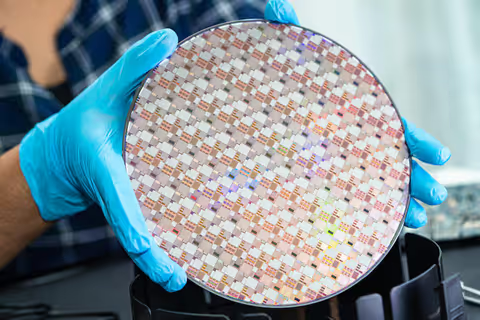
On one tiny piece of silicon, engineers found a way to fit dozens of transistor units together. Because of that shift, machines grew stronger without needing more space.
Few tiny parts link up inside modern chips, forming patterns that pack a huge number of switches. These connections twist and branch into shapes far beyond what once seemed possible.
Integrated circuits are used in:
- CPUs
- GPUs
- Memory devices
- Network equipment
- Embedded systems
Out of this came a stepping stone for today’s digital world. Though quiet in announcement, it shaped what followed in ways few expected.
Transistor Tech Changes Over Time
Faster computers push tiny switches to change shape over time.
Smaller Semiconductor Nodes
Chips now pack more transistors thanks to shrinking sizes made by makers. Efficiency climbs when tiny circuits replace bulkier ones. Tiny spaces on silicon open room for extra components. Speed jumps as distances between parts shrink down.
Artificial Intelligence Hardware
Out of nowhere, faster transistors are becoming essential for today’s smart machines. These days, custom-built processors quietly boost how well computers learn tasks.
3D Chip Designs
Vertical stacking of parts inside chips is being tested by a few firms aiming to boost speed while using less room. Chips built upward instead of outward help cut down area on circuit boards. A handful of businesses now experiment with 3D designs where layers sit one above another. Performance gains come when elements link across levels rather than stretch wide. Shrinking footprint matters just as much as faster operation for these new setups.
Advanced Semiconductor Materials
Out of nowhere, new materials are being tested by scientists looking past silicon. These options might handle heat better while making transistors work smoother. Instead of sticking to old standards, teams explore substances that switch faster under stress. Efficiency gets a quiet boost when the base changes unexpectedly. Heat spreads differently in these forms, which matters just as much. Progress shows up quietly through tiny shifts in atomic behavior.
Things to Think About When Using Transistors
Even so, transistors bring useful advantages alongside serious design challenges. Yet every benefit comes paired with complex trade-offs engineers must weigh carefully.
Heat Management
Faster chips tend to produce more warmth during use. Without effective heat management, performance can falter.
Manufacturing Complexity
Fine tools shape tiny switches, each made where dust cannot reach. Machines work in sealed spaces so small parts stay pure by accident of airless rooms.
Power Consumption Balance
Performance needs careful handling alongside battery life when building devices you carry around. What matters most shows up in how long it runs without charging. Decisions shape results quietly behind the scenes.
Physical Size Limits
Fine details start to blur when transistors shrink too far, pushing makers to rethink how they build them. Tiny scales bring fresh hurdles, forcing shifts in strategy just to keep moving forward.
Conclusion
Out of nowhere, tiny switches made machines work completely differently. Instead of bulky glass tubes, these new parts took over, quietly making gadgets shrink while speeding them up. Efficiency jumped - no fanfare, just results.
Computers, phones - everywhere you look, tiny switches shape how gadgets behave. Progress in these small parts pushes forward smarter machines, better chip production, along with stronger networks that keep data moving.
Peering into transistors reveals much about the journey of today’s tech - its growth never really stops. How things shifted through decades shows up clearly when you study these tiny switches. Their quiet presence shaped what devices can do, slowly pushing limits further. Progress hides in such small parts, yet drives huge changes without fanfare.